April 27

Graphic Organizers for Math

by C. Elkins, OK Math and Reading Lady
Here are some cool graphic organizers for your math files!  Make sets of them, laminate or put in plastic sleeves, and use them over and over again!  Graphic organizers help students stay organized and teach them how to complete problems neatly. They are also a great way for students to show different strategies for the same problem. While primary students may need an already-made graphic organizer, intermediate students should be taught how to duplicate them on their own to use whenever the need arises – so the simpler, the better! With repeated use, students are more likely to utilize them regularly in their daily work (and on their scratch paper with assessments).

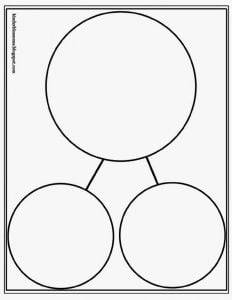
This one has ten frames and part-part-whole models. In my opinion, these are essential when working with K-2 students because they help children with subitizing, number bonds, and addition / subtraction facts.  If you are using Saxon, you are missing these important strategies!!:

Here’s one to show fractions (area, set, length models)

Need a template for students to make arrays? This one is ready!  I love showing students how to break an array into smaller parts to see how multiplication (or division) facts can be decomposed.  Example:  Make a 6 x 7 array.  Section off a 6 x 5 part. Then you have a 6 x 2 part left over.  This proves:  6 x 7 = (6 x 5) + (6 x 2).  Or — 6 x 7 = 30 + 12 = 42

This graphic organizer shows 5 different multiplication strategies using 2 digit numbers, and a blank one for students to record their thinking. Very handy!!  One of my favorite strategies is partial products. I highly recommend this one before going to the std. algorithm because students decompose the problem by place value and must think about the whole number and not just the parts.

Do your students need something to help them see the different models for a decimal? Try out this graphic organizer. Students will utilize the pictorial forms as well as the abstract.

Do your students know that .7 (or 7/10) is the same as .70 (or 70/100)?  Using this dual set of tenths and hundredths grids will help them see why this is true!

Be sure to check out my FREE templates and organizers (see black bar above “links . . .”)  Please share your favorite graphic organizers for math!  Enjoy!!
April 18

Graphic Organizers for Literacy

by C. Elkins, OK Math and Reading Lady

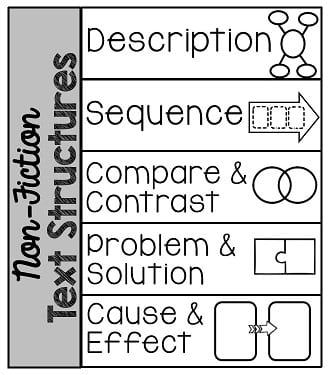
I highly recommend the use of graphic organizers. The purpose is to help students organize information with regard to different text structures:  

  • Compare and contrast
  • Cause and effect
  • Details / Descriptive
  • Problem and solution
  • Sequence

Graphic organizers are also helpful with standards such as:

  • Main idea
  • Summarizing
  • Character analysis
  • Story elements

Graphic organizers help organize the student’s thinking, and assist with note-taking. The visual pictures created help the student “see” the text structure, recall details, state the main idea, and summarize the selection.

Here are links to some sites I think provide good quality graphic organizers which can be utilized with a variety of situations:

  1. This one is more primary oriented: https://www.eduplace.com/graphicorganizer/
  2. This one is oriented more for 3rd and above: http://www.educationoasis.com/printables/graphic-organizers/
  3. This one is a FREE resource at TPT (as pictured above) that supports each of the 5 text structures: https://www.teacherspayteachers.com/Product/Non-Fiction-Text-Structures-Flip-Flap-and-Graphic-Organizers-Freebie-1777102

I have also linked these in “Instructional Resources” and in the categories list on my blog.  Enjoy!!

April 13

Division Basics Part 3: Repeated Subtraction and # Line

by C. Elkins, OK Math and Reading Lady÷

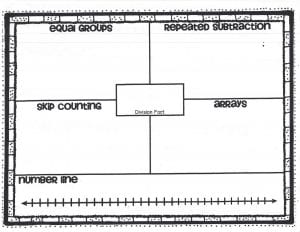
In my opinion, the process of repeated subtraction is very important for students to practice. With repeated subtraction, we are actually asking this question:  “How many _____ in _______?”  If the problem was 20÷4, we can ask, “How many 4’s are in 20?”  The process is to keep subtracting 4 (using concrete, pictorial, and abstract methods) until zero is reached.  This would be done 5 times — thus, 20 ÷ 4 = 5.

Much like multiplication, there are different aspects of division children should become familiar with.

  • Arrays 
  • Equal Groups
  • Repeated Subtraction
  • Number lines
  • Skip counting

The focus today will be to help children understand how repeated subtraction can assist with the division process (using manipulatives, drawings, and paper-pencil methods). The template pictured here is FREE from: Multip. and Division templates FREE from Number Two Pencils @ TpT

The reason the repeated subtraction strategy is important is because this is what we are really asking students to do when they encounter long division or partial quotient problems. With the problem 100 ÷ 4, the question is, “How many 4’s are in 100?” If the repeated subtraction process is used, the answer is of course, 25.  But subtracting 4 twenty-five times is not very efficient.  So we want the student to get closer to 100 and subtract larger amounts than 4 at a time. The partial quotients method would allow the student to do this in chunks.  1 solution could be to subtract 40 (ten 4’s), subtract another 40 (ten more 4’s), subtract 20 (five 4’s).  See picture below: Continue reading

April 6

Division Basics Part 2: Equal Groups

by C. Elkins, OK Math and Reading Lady

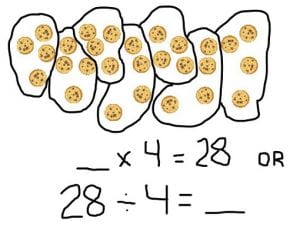
Last post featured division using arrays and the area model.  This post will focus on helping children see division as equal groups. Most of us have used the “plates of cookies” analogy to help kids see how to represent equal groups in a drawing.  I will just take that a few more steps to increase efficiency.
Much like multiplication, there are different aspects of division children should get familiar with:

  • Arrays 
  • Equal Groups
  • Repeated Subtraction
  • Number lines
  • Skip counting

In this post, I will break down the benefits of equal groups models to help children understand division (and how it is related to multiplication). Check out the freebies within this post.

If you haven’t utilized this book with your students, please try to find a copy!  It’s called The Doorbell Rang by Pat Hutchins.  In this story, Ma makes some cookies to be split between the kids.  Then the doorbell rings and more kids come, so the problem has to be refigured. This scenario repeats. As a class, you can duplicate the story with a different # of cookies and children.

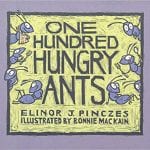
Another great story emphasizing equal groups (as well as arrays) is the story One Hundred Hungry Ants by Elinor Pinczes.  In this story, 100 ants are on their way to raid a picnic. They start off in one straight line (1 x 100), but then rearrange into different equal groups to shorten the line (2 lines of 50, 4 lines of 25, etc.). A nice project after reading this book is to see how many ways a different given # of ants (or other animals / objects) can be divided into equal groups / rows.
 

By clicking on the links for each book above, you will be taken to Amazon for more details.

As I mentioned earlier, many children’s view of equal groups regarding division is to use manipulatives and/or draw circles / plates to match the divisor and then divide up the “cookies” equally in these groups.  Let’s say you had this problem: “There are 12 cookies to be divided onto 3 plates equally.  How many cookies would go on each plate?” As you observe the students:

  • How are they dividing up the cookies? One at a time, two at a time, randomly, trial and error?
  • Are the “cookies” scattered randomly on the plate / circle?  Or, are they arranged in an easy-to-see pattern so they are easily counted (by the student and yourself as you walk around the room)?
  • Are the students able to verbally tell you how they divided them?
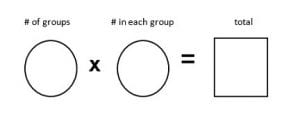
  • Are the students making the connection to multiplication by noting that 3 x 4 = 12?
  • Can they solve similar problems using language other than plates / cookies?
    • Try shelves / books; trays / brownies; buildings / windows; flowers / petals; students / rows of desks, stars / # of points; aquariums / fish; boxes / donuts; etc.

Use of manipulatives of various types (cubes, tiles, counters) is important for children to have their hands on the objects being divided. This is how they work out their thinking. Then work toward paper/pencil drawings before going to the abstract use of numbers only.  This doesn’t have to be done in separate lessons, however. There is great value for children to see how the concrete, pictorial, and abstract representations all work together.

Also, help children list synonyms for the dividing process:  distribute, share, split, separate, halve, quarter, partition

Here are a few strategies I believe help make the equal groups process more efficient: Continue reading