by C. Elkins, OK Math and Reading Lady
Solving comparison problems involves a different thinking process than addition or subtraction problems. In my previous posts Math Problem Solving Parts 1 and 2, I focused on addition and subtraction problems in which I advised students to think of the verbs used (found, bought, earned, spent, lost, gave away, etc.) to help visualize what is going on in the story. In comparison problems, there are no additive or subtractive processes present – just analyzing which has more, which has less, and how much more or less one amount is compared to another.
I love using a double bar method for comparison problems. It can be represented with manipulatives for a concrete experience (ex: connecting cubes, tiles) or with a drawing of two rectangular bars for a pictorial representation. These two visual models provide students with the concept of comparison — they can see right away which has more, which has less. Then the information can be used to compare the two amounts. Look for the FREE resource at the end of this post.
With manipulatives:
I recommend the use of manipulatives when dealing with students’ first experience with comparison problems. Dealing with quantities less than 20 make using manipulatives manageable. I will show this in a horizontal format, but it can certainly be done vertically. You can also apply this quite well to graphing problems.
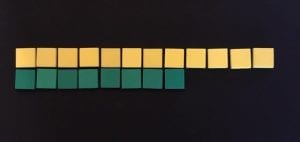
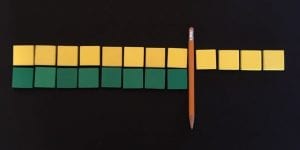
Problem: I have 12 crayons. My friend has 8 crayons. How many more crayons do I have than my friend?
-
-
- Determine that this problem is not an addition / subtraction process (because no one is adding to what they have and no one is giving away what they have), but in fact a comparison problem.
- Be cautious about focusing on the question”how many more” and telling students that when they see this they need to subtract. When we tell kids to focus on the specific words in a question with a “rule” for adding or subtracting, they start to lose sight of the actual story.
- Consider that this question can also be used with a SSM (some and some more) story which is not a comparison problem: What if it read: “I have 8 nickels. I want to buy a candy bar that costs 80 cents. How much more money do I need?” This story means: I have some (40 cents) and I need some more (?) so that I have a total of 80 cents. This is a missing addend or change unknown story: 40 + ___ = 80. Even though it could be solved in a similar manner as a comparison story, we want students to be able to tell the difference in the types of stories they are solving.
- Determine who has more (represented by yellow tiles), who has less (green tiles).
- The crayon problem can be solved by lining up 2 rows of manipulatives (pictured):
- Notice the extras from the longer bar. Count them (4)., or
- Count up from 8 to 12 to find the difference.
- Even if the question was “How many fewer crayons does my friend have?” it would be solved the same way.
With pictorial double bars:
Problem Type 1 (Both totals known): Team A scored 85 points. Team B scored 68 points. How many more points did Team A score than Team B?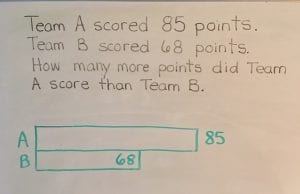
- Determine this problem is not an addition / subtraction process (because the teams are not gaining or losing points).
- Ask “Who?” and “What?” this story is about: Team A and B and their scores.
- Draw double bars (one longer, one shorter) which line up together on the left side.
- Label each bar (Team A, Team B).
- For the team with the larger amount (Team A), place the total outside the bar (85).
- For the team with the smaller amount (Team B), place the total inside the bar (68).
- Make a dotted line which extends from the end of the shorter bar upward into the longer bar.
- Put a ? inside the extended part of the longer bar. This is what you are trying to find.
- To solve, there are 2 choices:
- 68 + ____ = 85 This choice might be preferred for those with experience using mental math or open number lines to count up.
- 85 – 68 = _____
Continue reading →