Geometry Part 4: More Composing and Decomposing

by C. Elkins, OK Math and Reading Lady  

There are so many good ways to help students compose and decompose shapes (2D and 3D), so I will focus on some more by using tangrams and 2D paper shapes. In case you missed it, my last post focused on ways to use 1″ color tiles and pattern blocks to compose and decompose shapes. Click HERE to link back to that.

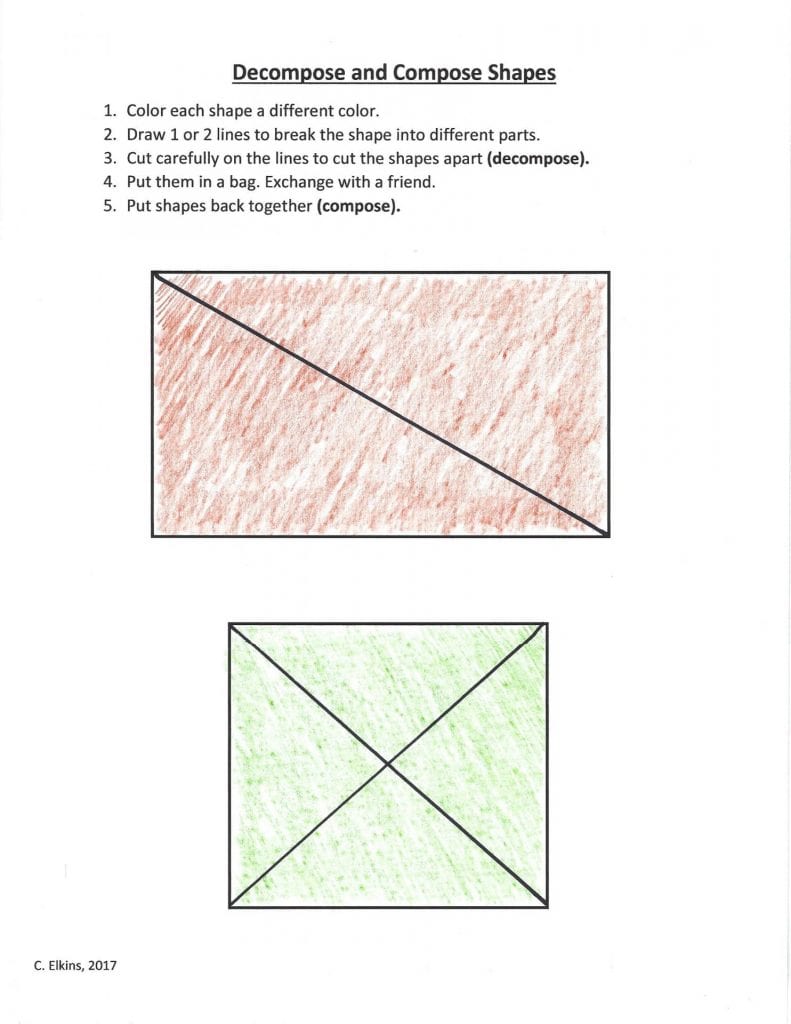
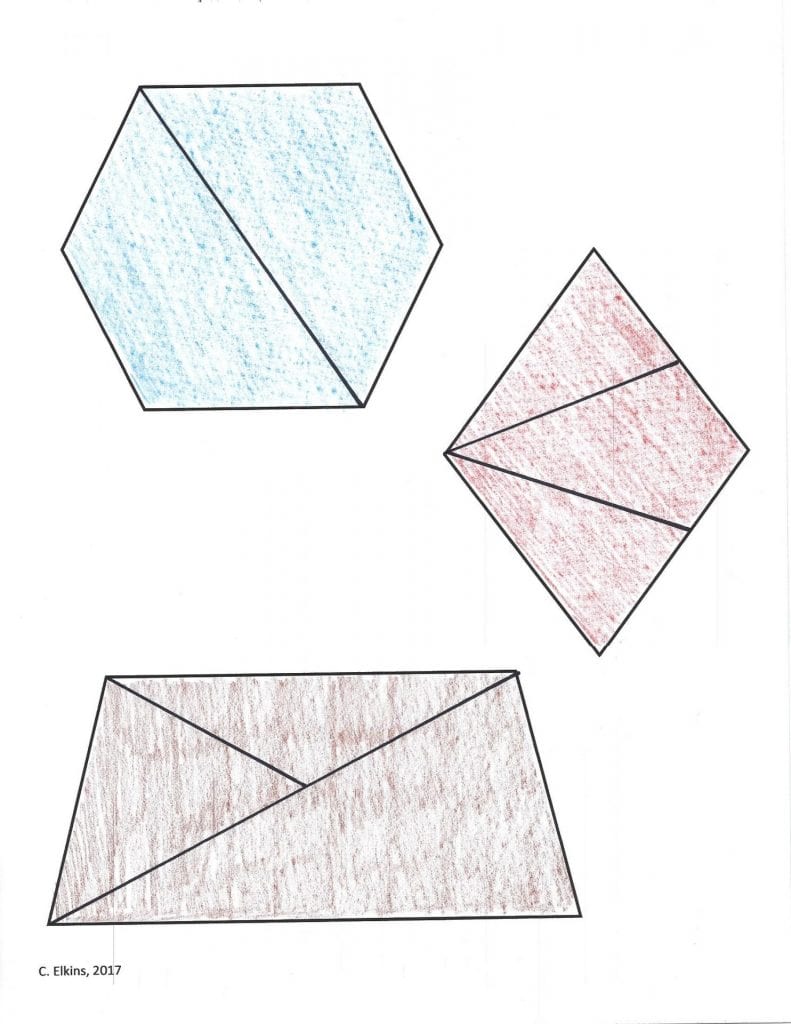
  1. Give students paper shapes of these polygons:  rectangle, square, hexagon, trapezoid, rhombus. Click here for a FREE pdf copy: Decompose and Compose Polygons.
    • Students should color each paper shape one solid color (a different color for each shape). My advice is to use light colors because they will be drawing lines on the shapes and light colors enable them to see the lines.
    • Model how to draw 1 or 2 lines to decompose the shape into smaller shapes.  For first and 2nd grade, I recommend you show them how to use at least one corner of the shape to connect to another corner or side using a straight edge or ruler. This way the newly created shapes will resemble ones they already know (triangle, trapezoid, rectangle). Older students can be given a little more leeway — their decomposing may result in other more irregular polygons. Here is one way to decompose.
    • Cut apart on the lines. Have students put their initials or name on the back of each piece (in case it gets separated or ends up on the floor).
    • Each student puts their cut-up pieces in a baggy for safe-keeping. Then the student can take them out and try to compose them back into their original shapes.  This is where the color-coding comes in handy (all the yellow go together, all the green, etc.).
    • Students can trade their baggies with others to compose their shapes.
    • When students are done with the shape puzzles, they can glue them back together on background construction paper (or take them home for practice, or keep at school for ongoing work).
    • Discuss together how many different ways these shapes were decomposed using 1 or 2 lines.
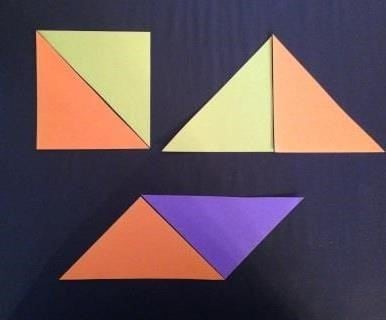
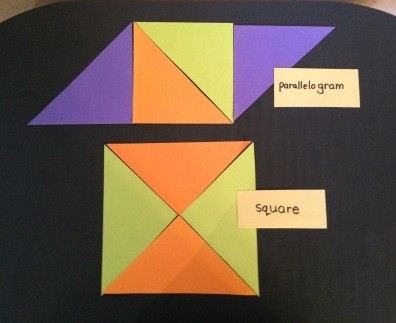
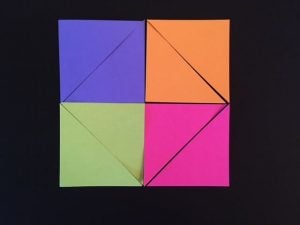
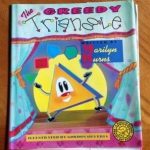
  2. Use the book, “The Greedy Triangle” by Marilyn Burns as a springboard to compose other polygons using various numbers of triangles.  In this book, the triangle keeps adding a shape to himself (after a visit to the “Shapeshifter”). There are many good pictures in this book illustrating common things with the named shape.  This is also a great way to connect art to math. You can start with squares which the students must cut in half on the diagonal, or start with pre-cut triangles. Length of edges must match. Level 0 students can just try out different combinations. Level 1-2 students would analyze the properties more and name the new shapes. You can even emphasize symmetry (as I have shown with the bottom row). Here is the link to the full article about this wonderful activity. Math Art: The Greedy Triangle Activity
Continue reading

Geometry Part 3: Composing and Decomposing

by C. Elkins, OK Math and Reading Lady

Composing and decomposing geometric shapes (2D and 3D) should be centered around concrete and pictorial methods. In this and upcoming posts, I will illustrate some methods using various manipulatives and line drawings which help students take a shape apart or put shapes together. If you refer back to  Geometry Part 1: The Basics, all grade levels KG-5th have standards dealing with this issue. Some of the experiences I plan to share will also help students relate to multiplication, division, fractions, area, and other geometry concepts (such as rotations, reflections, slides).

Refer to Geometry Part 2: van Hiele levels to determine if the activities you are choosing are appropriate for Level 0, 1, or 2 students.

One Inch Color Tiles:

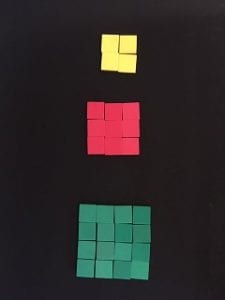
1.  Can you make a larger square out of several individual squares?

  • Level 0 students will be using the visual aspect of making it look like a square.
  • Level 1 students will be checking properties to see if their squares are indeed squares (with the same number of tiles on each side).
  • Level 2 students will be noticing they are creating an array (ex: 3 x 3 = 9) and perhaps learning about squared numbers. 3 squared = 9. They might be able to predict the total number of tiles needed when given just the length of one side.

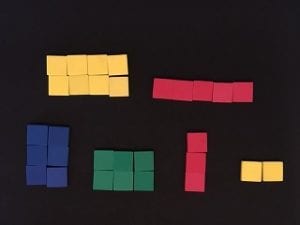
2.  How many rectangles can you make using 2 or more squares? (Level 0-1)

  • Level 1:  Are the green and blue rectangles the same size (using properties to determine)?

Continue reading

Geometry Part 2: Learning Continuum (van Hiele)

by C. Elkins, OK Math and Reading Lady

Today’s post will focus on an aspect of geometry involving levels of thought.  We know PreK or KG students aren’t ready for formal definitions regarding shapes. Starting about 2nd grade, students might be ready to describe shapes using specific attributes. Pierre and Dina van Hiele are Dutch math educators who have an excellent way to describe how children move through these geometric thinking levels.  They are called “The van Hiele Levels of Geometric Thought.” Click on this link for a full description:  The van Hiele Model   Also – some good resources at the end of this post.

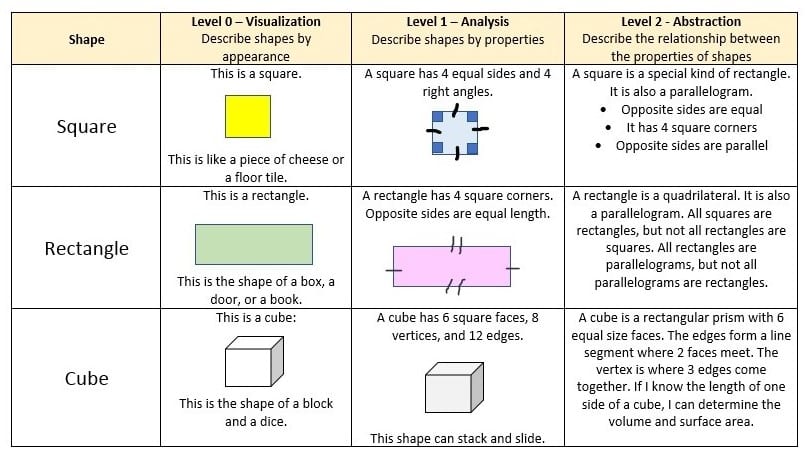
I became interested in these levels as I was doing research about better ways to help students master standards in Geometry.  (See more information below regarding these levels.)  Am I supposed to teach them the “proper definition” of a square in KG? At what point should students begin to understand the specific properties of a square – that it is actually a specific type of rectangle. And . . . when is it appropriate to help students realize that a square is also classified as a rhombus, rectangle, parallelogram, and quadrilateral? Click on the link for a pdf copy of the chart below: van Hiele Levels 0, 1, 2

What can we as teachers do to help them move through the levels? According to van Hiele, the levels can’t be skipped – children must progress through each hierarchy of thought. So while there is no grade level attached to these levels,  I like to think of the Visualization Level as the beginning point most appropriate for PreK-1st or 2nd grade students. Level 1 thinking might surface in grade 2 or 3 (and up). Students capable of Level 2 thinking may start with 3rd – 8th grade. Students in high school geometry might function at Level 3 thinking.

One of the properties of the levels he described has the name of “Separation.” The article linked above states: A teacher who is reasoning at one level speaks a different “language” from a student at a lower level, preventing understanding. When a teacher speaks of a “square” she or he means a special type of rectangle. A student at Level 0 or 1 will not have the same understanding of this term. The student does not understand the teacher, and the teacher does not understand how the student is reasoning. The van Hieles believed this property was one of the main reasons for failure in geometry. Teachers believe they are expressing themselves clearly and logically, but their Level 3 or 4 reasoning is not understandable to students at lower levels. Ideally, the teacher and students need shared experiences behind their language.

Here’s a closer look at the levels. Continue reading

Geometry Part 1: The Basics

by C. Elkins, OK Math and Reading Lady

For many schools, it seems as if Geometry and Measurement standards remain some of the lowest scored. This has always puzzled me because it’s the one area in math that is (or should be) the most hands-on — which is appealing and more motivating to students. Who doesn’t like creating with pattern blocks, making 2 and 3D shapes with various objects, using measurement tools, and getting the chance to leave your seat to explore all the classroom has to offer regarding these standards? So what is it about geometry and measurement that is stumping our students? Here are some of my thoughts – please feel free to comment and add your own:

  • Vocabulary? (segment, parallel, trapezoid, perpendicular, volume, area, perimeter, etc.)
  • Lack of practical experience? Not all homes have materials or provide opportunities for students to apply their knowledge (like blocks, Legos, measuring cups for cooking, tape measures for building, etc.).
  • Background knowledge about the size of actual objects? We take it for granted students know a giraffe is taller than a pickup truck. But if students have not had the chance to go to a zoo, then when they are presented a picture of the two objects they might not really know which is taller / shorter. Think of all of the examples of how we also expect students to know the relative weights of objects. Without background knowledge or experience, this could impede them regarding picture type assessments.
  • Standards keep getting pushed to lower grades when students may not have reached the conservation stage? If they think a tall slender container must hold more than a shorter container with a larger diameter, or they think a sphere of clay is less than the same size sphere flattened out, they may have difficulty with many of the geometry and measurement standards.

In this post, I will focus on Geometry. Here is a basic look at the geometry continuum (based on OK Stds.):

KG:  Recognize and sort basic 2D shapes (circle, square, rectangle, triangle). This includes composing larger shapes using smaller shapes (with an outline available).

1st:  Recognize, compose, and decompose 2D and 3D shapes. The new 2D shapes are hexagon and trapezoid. 3D shapes include cube, cone, cylinder, sphere.

2nd: Analyze attributes of 2D figures. Compose 2D shapes using triangles, squares, hexagons, trapezoids and rhombi. Recognize right angles and those larger or smaller than right angles.

3rd:  Sort 3D shapes based on attributes. Build 3D figures using cubes. Classify angles: acute, right, obtuse, straight.

4th:  Name, describe, classify and construct polygons and 3D figures.  New vocabulary includes points, lines, segments, rays, parallel, perpendicular, quadrilateral, parallelogram, and kite.

5th: Describe, classify, and draw representations of 2D and 3D figures. Vocabulary includes edge, face, and vertices. Specific triangles include equilateral, right, scalene, and isosceles.

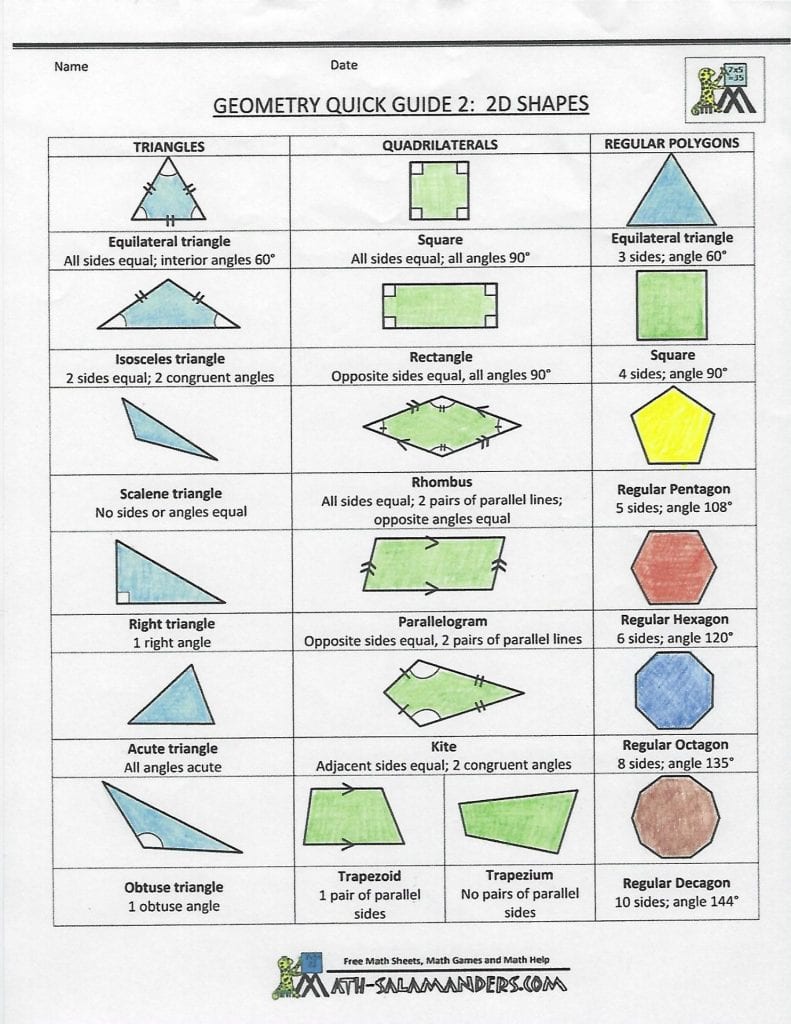
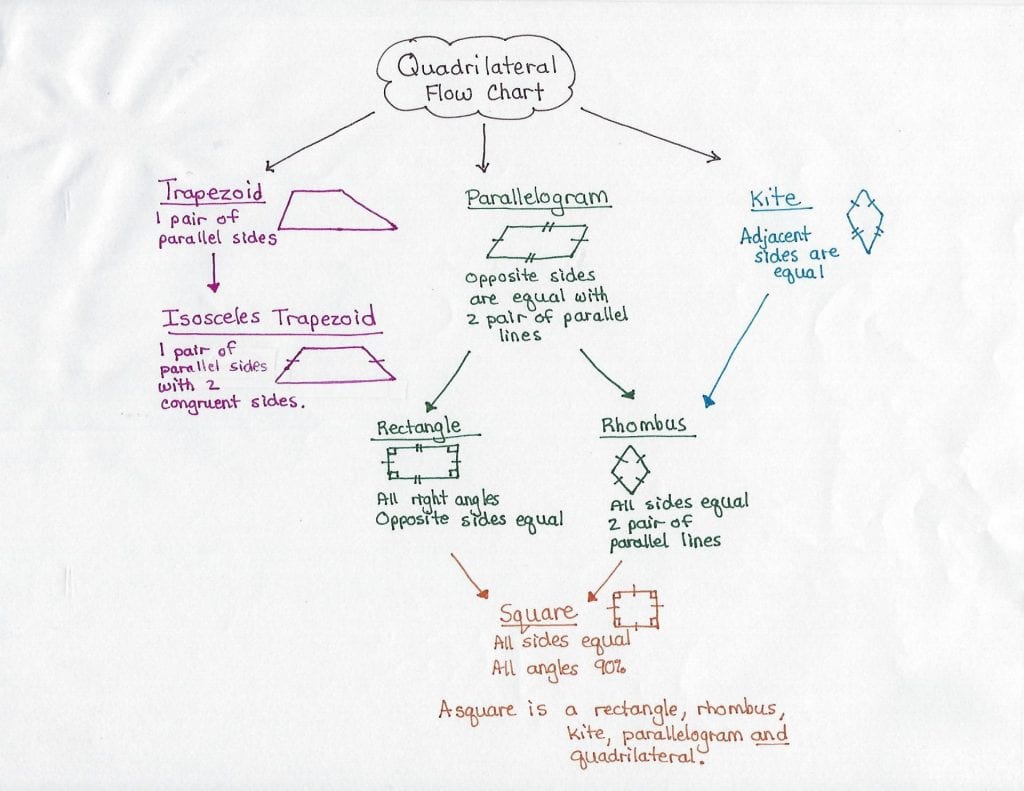
Here are a couple of guides that might help you with definitions of the various 2D shapes. The 2D shapes guide is provided FREE here in a PDF courtesy of math-salamander.com.  I included a b/w version along with my colored version. The Quadrilateral flow chart I created will help you see that some shapes can have more than one name. Click on the link for a free copy (b/w and color) of the flow chart. Read below for more details about understanding the flow chart.

PLEASE note these very important concepts: Continue reading