by C. Elkins, OK Math and Reading Lady
The next few posts will continue to focus on the basic multiplication concepts one at a time. This will allow the opportunity to dig deeper into the concepts we want students to understand. This one will focus on the concept that multiplication is repeated addition. These posts will be helpful to teachers introducing multiplication to students in 2nd and 3rd grade as well as those in 4th, 5th, 6th and beyond who have missed some of these basic concepts. Future posts will focus on the area (array), set (equal groups), counting, decomposing, and doubling/halving models as well as the associative and distributive properties. Freebies below!!
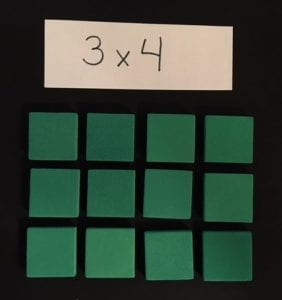
Do your students know what the “times” sign means? They may hear it frequently, but not realize what it means. I like to interpret it as “groups of.” So a problem like 3 x 4 can be said as “3 groups of 4.”
To show repeated addition, that same problem would be 4 + 4 + 4 = 12.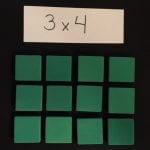
Repeated addition can be shown with numbers, and also with arrays and equal groups. These pictorial models are great for developing multiplication concepts (and will be topics of future posts). However, when students are presented with these models they often count the individual pieces one at a time rather than adding the same amount repeatedly. Observe your students to see how they are counting. . . and encourage counting in equal groups to promote a growth of the multiplication mindset.
Do your students apply the commutative property of multiplication? This means if the problem is 3 x 4, it can also be solved by thinking of 4 x 3 (which is 4 groups of 3 OR 3 + 3 + 3 + 3). I want students to know even though the answers are the same, the way the factors are grouped is different. When used in a story, 3 x 4 is a different scenario than 4 x 3.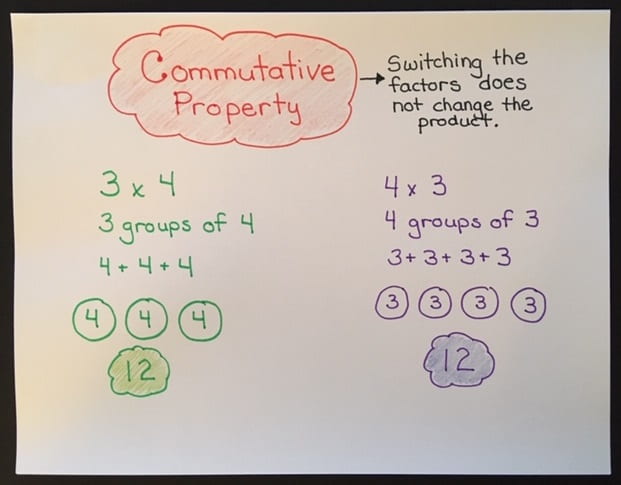
Do your students practice repeated addition, by combining 2 or more numbers? See the following for an illustration of 15 x 6:
Do your students apply the concept of repeated addition to multiple digit multiplication problems as well? I have witnessed students numerous times who only try a problem one way and struggle. For example, on a timed test I witnessed a 5th grader attempt the problem 12 x 3. I observed him counting by 3’s. He was trying to keep track of this by skip counting by 3’s twelve times (using his fingers). I could tell he had to start over frequently, thus spending a lot of time on this one problem. It became obvious he had no other strategy to try. He finally left it blank and went on. Just think if he had thought of 12 + 12 + 12. This should have been relatively easy for a 5th grader. He also could have decomposed it to this: (3 x 2) + (3 x 10).
Do your students always go to the standard algorithm when they could perhaps mentally solve the problem by repeated addition? If the problem was 50 x 3, are they thinking 50 + 50 + 50? Or are they using paper-pencil and following the steps?
What about a problem such as 45 x 4? Using repeated addition, is your student thinking of 40 + 40 + 40 + 40 combined with 5 + 5 + 5 + 5? This is then solved as 160 + 20 = 180.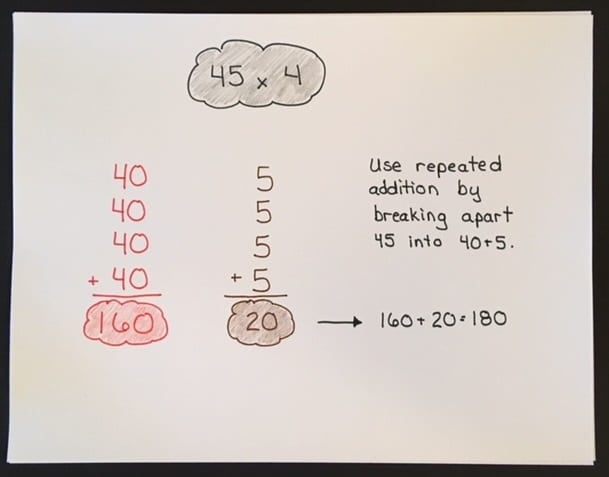
Here are a few resources (FREE) that might help with this strategy:
- Here’s one I developed to practice double digit x single digit problems: Multiplication is repeated addition double digit x single digit problems CE
- Chart/worksheet to show multiplication as picture, repeated addtion, equal groups (Free on TPT from Dotty Fobes)
- Repeated addition for mult. games (Free on TPT by Games 4 Gains)
Students who are able to use repeated addition skillfully are showing a healthy understanding of place value and multiplication. This strategy also enhances mental math capabilities. Conducting daily number talks are highly advised as a way to discuss multiple ways to solve a given problem such as those mentioned above. Check out “Number Talks” in my category list for more information on this. Also check out some recommended videos about conducting number talks (above black bar “Instructional Resources”).
 One way is to skip count or repeatedly add the number over and over again. While this is one acceptable strategy, I see many students skip count using their fingers, often starting over numerous times. And if the child miscounts just one number in the sequence, then all of the remaining multiples/products are incorrect. Sometimes the student will write down the sequence in a horizontal row (better than using fingers in my opinion), but again – if they miss one number . . . all the rest of the numbers in their list are wrong.