by C. Elkins, OK Math & Reading Lady
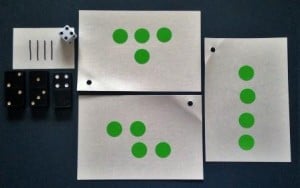
Students know how to count orally, can subitize, can count on one more, know ordinal positions, and have cardinality (know that the last number counted is the number of objects). These are usually prerequisites with number sense before introducing the symbolic representation and base ten understanding. Our system is based on the repeated groupings of ten. This is a follow up from my last post (Place Value Part 1 — counting).
There are two levels of understanding place value symbols.
- Place value: In the number 23, the 2 has a place value representing the tens place.
- Face value: With 23, the 2’s value is 2 tens or 20.
This shows 23 and 32 are not the same amount even though they use the same digits. Conversely, this same understanding applies to decimals. For example, .4 is the same value as .40.
Here are some ways to help students develop place value competence. Below this section are activities to help teach and practice:
- Organize objects into groups when counting.
- If given a group of 72 objects, do students try to count them one at a time (and probably losing count somewhere along the way)? Or, can they make specific size groups such as 10’s to see they have 7 groups of 10 and 2 extra?
- If given a group larger than 100 (like 134), do they note that 13 groups of ten is the same as 130?
- Partition numbers into groups based on powers of ten (ones, tens, hundreds).
- Students learn that 52 = 5 tens, 2 ones = 50 + 2
- Students learn that 348 = 3 hundreds, 4 tens, 8 ones = 300 + 40 + 8
- Students learn that .45 = 4 tenths, 5 hundredths = .4 + .05
- Realize the relationship among the different places. Using the number 67 . . .
- Most frequently it is represented as 6 tens, 7 ones.
- But it can also be represented as 5 tens, 17 ones (which by the way is crucial to understanding the regrouping process for subtraction. Show your students a problem in which regrouping is needed for 67, with the result of 5 tens 17 ones. Ask them if 5 tens, 17 ones = 67? How many think no?).
- 67 can also be represented as 4 tens 27 ones, and so on.
A clear understanding of these three guiding concepts of place value are very important and you will do well to thoroughly help students experience them before embarking on number operations.
Some activities to help with the above:
Organizing:
- Provide objects for students to count: beans, cubes, tiles, candy, popcorn kernels, etc. Depending on the size of the objects, give directions such as “take a handful” or a spoonful, or a cupful. Make it a competition with a partner, who has more? who has less? Provide different containers for students to compare which holds more or less (and thus, working a little on measurement standards and conservation of space understanding).
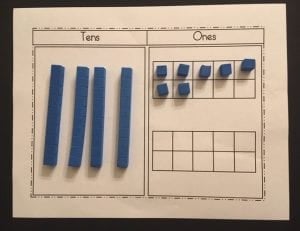
- Use base ten ones units. Give an amount and after making piles of tens, have student trade each pile for a tens rod. How many tens? How many ones?
Partitioning:
- Build given numbers with base ten pieces. Example: “Build 47”
- Match pictures with expanded form using task cards.
- I recommend using place value pieces for KG and 1st graders because the pieces show the relationship (a tens rod is 10 ones units stuck together, the 100’s flat shows ten 10s and 100 units). For 2nd and up, it might be more feasible to use the place value disks because these allow students to work with larger amounts. I know I never had enough hundreds’ flats to build larger numbers. Here’s a link to place value disks on Amazon: Place value disks
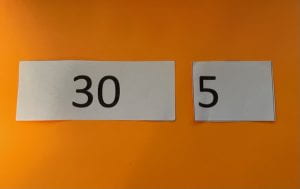
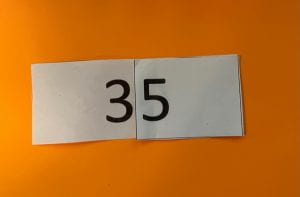
- Use place value number strips that layer: 2000 + 500 + 30 + 8 when laid on top of each other shows the number 2,538. See sample here at Amazon: Place value layered strips
- Work on mental math thinking of adding tens and ones: 10 + 2 = 12, 30 + 5 = 35, 70 + 6 = 76. I often use this technique to show visually what we want our brain to do. These are tens and ones layered strips I made, available here for free: Digit cards 0-10 and 10-100
-
Relationships:
- Practice making exchanges with place value pieces. Build a number the standard way (67 = 6 tens, 7 ones). Then exchange a ten for ten ones. Verify that 5 tens 17 ones = 67.
- How many ways can you show this number? (Give a number and provide manipulative for students to check and list.)
- Using base ten rods and flats, verify that 15 tens = 1 flat + 5 tens (100 + 50)
- Show how number changes by changing the ones or the tens.
-
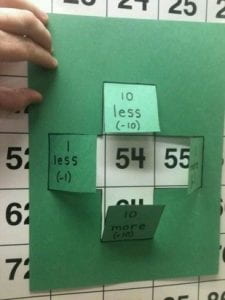
- What is 10 more? 10 less?
Use a 100 chart. Select a number and find what ten more or ten less would be — also 1 more, 1 less. Use the chart to show ways to count by tens other than the traditional 10, 20, 30, etc. Try 27, 37, 47, 57. Practice counting forward as well as backwards.
-
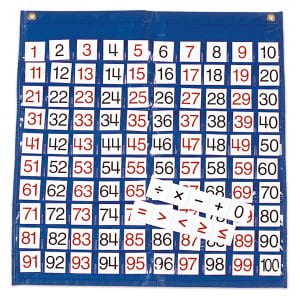
Important tip when using base ten manipulatives (from personal experience):
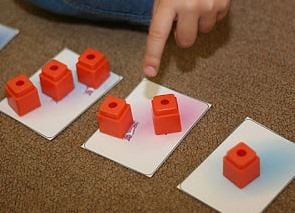
When students are using base ten pieces, don’t allow random placement of the ones on their work mat. Why? This often means a student may not have the correct amount because they miscounted their “mess.” It also means the teacher has to spend more time when circulating the room to count their “mess” to check for correctness.
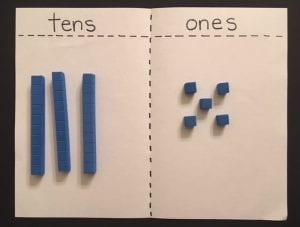
The ones cubes are organized!
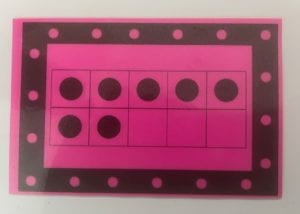
All it takes is noticing the student(s) who likes to organize their ones pieces. Their 5 pieces look like the dots on a dice or how it might look on a ten frame, or the 9 ones are in 3 rows of 3. As the teacher, you can show others how this is so helpful to you (and them) to arrange them in some kind of order. Knowing they get some choice in the order is key. And noticing how different students show the same amount in different ways is an ego booster to most students. Finally, it really does help boost students’ understanding of number bonds when they show 5 can be 4 and 1, or 2 and 3, or 2 and 2 and 1. That’s a two for one, right?
Enjoy your place value lessons — and share some you think would also be helpful!
Take care, stay safe!